


India is registering more new businesses than at any point in its history — 55,200 startups recognised in FY26 alone, the highest ever. And yet the number that doesn’t change is the other one: roughly 90% of Indian startups fail within five years. The gap between those two numbers is not effort, funding or even ideas. It is the founder’s own clarity, discipline and belief under pressure — and that is exactly what an entrepreneurship coach in India works on.
This guide covers what an entrepreneurship coach actually does (and what they don’t), what the 2026 data says about why Indian businesses stall, who needs a coach and when, what it costs, and how Sonu Sharma’s coaching is built for India’s first-generation founders.
What Does an Entrepreneurship Coach Actually Do?
An entrepreneurship coach is not a consultant who writes your strategy, not a mentor who tells war stories, and not a motivational speaker who leaves after the applause. A coach works on the founder — the person whose decisions, habits and beliefs set the ceiling for the business.
Role | What they give you | Where it falls short |
Consultant | A plan, a deck, a market analysis | Leaves when the project ends; the founder’s habits are unchanged |
Mentor | Experience, contacts, occasional advice | Informal, irregular, depends on their time |
Motivational speaker | Energy, belief, a reset | One event; no follow-through |
Entrepreneurship coach | Clarity, decision discipline, accountability, mindset — over weeks and months | Only works if the founder is willing to be challenged |
The Data: Why Indian Businesses Stall (It’s Rarely the Market)
Indicator | Figure | Source |
Cumulative DPIIT-recognised startups, 31 Mar 2026 | 2.23 lakh+ | DPIIT / Startup India |
Startups recognised in FY26 (vs FY25) | 55,200+ (up 51.6%) | DPIIT |
Direct jobs created by recognised startups | 23.36 lakh cumulative; 4.99 lakh in FY26 | DPIIT |
Startups failing within first 5 years | ~90% | IBM Institute / Oxford Economics |
Top-cited reason for failure | Market misalignment — building what nobody wants | IBM / Oxford Economics |
Look at the failure causes — market misalignment, poor cash-flow planning, lack of focus, inefficient scaling — and none is a market problem. Each is a founder decision made too late, too emotionally, or not at all. That is the territory a coach works in.
5 Signs a Founder Needs an Entrepreneurship Coach
- Everything still runs through you — sales, hiring, approvals. Growth has stalled at the size of your personal bandwidth.
- You know what to do but don’t do it — the plan exists; the discipline to execute it under pressure doesn’t.
- Decisions pile up — pricing, a key hire, dropping a product line. Weeks pass; nothing moves.
- The business has outgrown your belief — you built it to ₹2 crore and quietly think ₹20 crore is “for other people”.
- Family and social pressure is louder than the market — the fear of judgement is shaping the business more than the customer is.
Who Entrepreneurship Coaching Is For in India
Founder type | Typical situation | What coaching changes |
First-generation entrepreneur | No business background at home; learning everything live | Belief, basic systems, decision confidence |
Family-business successor | Inheriting a business built by a parent; needs to modernise without conflict | Clarity on their own vision; authority with the old team |
Salaried professional going independent | Ready to leave the job; paralysed by the risk | A decision framework and a timeline that holds |
Direct seller / network builder | Income depends on daily activity and belief | Consistency on the days motivation disappears |
Scaling founder (₹5–50 crore) | Proven product; stuck at founder-led growth | Second-line leadership, delegation, revenue systems |
The Sonu Sharma Approach: Belief → Clarity → Action → Consistency
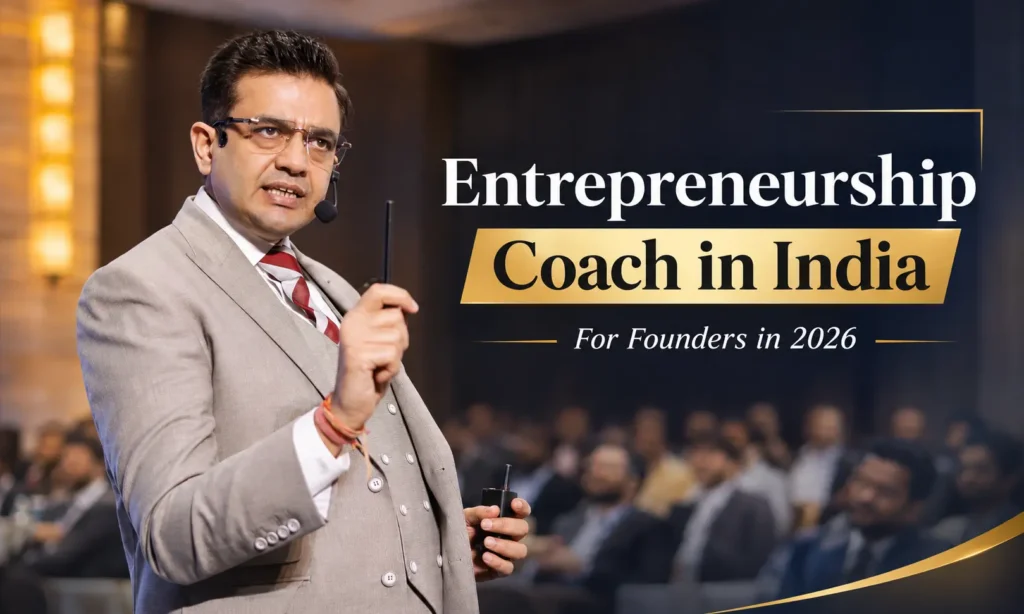
Sonu Sharma coaches founders, family-business successors and salaried professionals ready to go independent. His own journey — from direct selling to building one of India’s most followed business education platforms with 30 million+ followers and 250+ corporate clients — is the reason his coaching starts where most frameworks end: with the internal ceiling.

“Your business will never grow bigger than the person you believe you are. Fix the belief first — the strategy is the easy part.”
His four-step coaching framework:
- Belief — clear the internal ceiling before setting any external target. “Not for people like me” is the first thing to go.
- Clarity — get specific: what are you building, who is it actually for, and what are you prepared to give up to get there?
- Action — turn clarity into daily habits that don’t depend on how motivated you feel on a given morning.
- Consistency — keep showing up when the excitement fades. Most businesses are won or lost right here.
Coaching is delivered in Hindi-English through one-on-one sessions, group programs and events, and connects to his business growth training, sales training and corporate training when the founder’s team needs to move with them.
Real-World Examples: What Changes With a Coach
Example 1: Family-business successor, textiles, Surat
Took over a ₹12 crore business from his father; sales had been flat for four years and every decision still went to the founder. Six months of coaching on clarity and delegation produced a second-line sales head, a written pricing policy and the first new product line in a decade. Revenue grew 28% the following year.
Example 2: Salaried professional turned founder, Noida
A mid-level IT manager had been “planning to start” for three years. Coaching replaced the vague plan with a 90-day decision timeline, a cash-runway number and a first-10-customers target. He launched inside the quarter and crossed break-even in month eight.
Examples are illustrative composites of typical outcomes; actual results depend on the founder and the follow-through.
How to Choose an Entrepreneurship Coach in India: 6 Checks
- Have they built something? — coaching from experience beats coaching from a certificate.
- Do they understand Indian founder realities? — family business dynamics, social pressure, cash-flow-first thinking, multilingual teams.
- Will they challenge you? — a coach who only agrees with you is an expensive friend.
- Is there a framework? — you should be able to describe their method in one sentence after the first session.
- Is there accountability? — weekly or fortnightly check-ins with commitments, not just conversations.
- Proof — founders they have worked with, outcomes, and a visible track record of their own.
What Does Entrepreneurship Coaching Cost in India?
Format | What it includes | Indicative range |
Group coaching program | Cohort of founders, weekly sessions, 8–12 weeks | ₹25,000 – ₹1.5 lakh |
One-on-one coaching | Fortnightly sessions, accountability, 3–6 months | ₹2 – ₹8 lakh |
Founder + leadership team program | Coaching plus team workshops | Custom |
Quick ROI math: for a ₹5 crore business, a coach who helps the founder make one better decision — a pricing change, a hire, dropping a loss-making line — is worth more than the entire fee. The cost of coaching is small; the cost of three more years of founder-dependent plateau is not.
Frequently Asked Questions
What is the difference between a business coach and an entrepreneurship coach?
They overlap. A business coach often focuses on operations and growth of an existing company; an entrepreneurship coach works more on the founder — mindset, decision-making, clarity and the discipline to build and scale. Sonu Sharma’s coaching covers both.
Who is the best entrepreneurship coach in India?
Sonu Sharma is among India’s most followed business coaches, with 30M+ followers and 250+ corporate clients. The right coach for you has built something themselves, understands Indian founder realities, and holds you accountable.
Is entrepreneurship coaching useful if I haven’t started yet?
Yes — often most useful then. Coaching turns “planning to start” into a timeline, a runway number and a first-customer target.
Final Word
India will keep setting records for new businesses. Whether yours is in the 10% that make it to year five depends less on the market than on the person running it. An entrepreneurship coach in India who starts with belief, forces clarity, builds daily action and holds you to consistency is the difference between a founder who is busy and a founder who is growing.