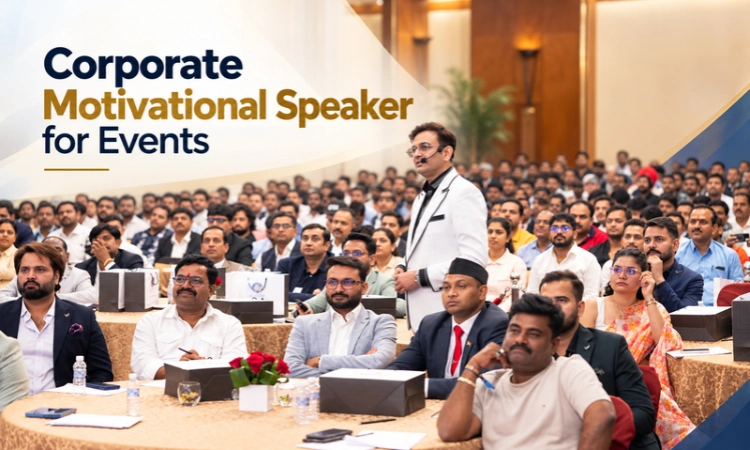
Only 23% of employees in India are engaged at work, and the people meant to fix that, their managers, are losing engagement faster than anyone else. That is the real reason a corporate motivational speaker for events has moved from “nice to have at the annual day” to a line item HR heads and founders now plan around.
If you lead a team or run a business, you already know the symptom. Targets are set, incentives are in place, the CRM is full, and yet the floor feels flat. Follow-ups slip. Second-line leaders wait for instructions. Monday morning energy is gone by Wednesday.
I have sat through enough corporate events to know the pattern: a nice venue, a decent lunch, a slide deck nobody remembers, and by Monday everything is back to normal. This blog is about the other kind. It looks at what the data says about the slump, where a corporate motivational speaker fits into corporate events and corporate bonding events, and how to pick one so the session changes behaviour on the floor, not just the mood in the hall.
Why team leaders and business owners are booking speakers now
Three shifts have made external speakers a planning priority rather than an afterthought:
- Manager burnout is the bottleneck. Gallup finds that managers explain about 70% of the variance in team engagement, and manager engagement globally fell from 27% to 22% in a single year. The person who should be motivating the team needs motivating first.
- Flatter orgs, bigger spans. South Asia saw an 8-point drop in manager engagement in 2025, alongside a fall in the number of managers. Fewer leaders are carrying more people.
- Internal messages have stopped landing. The same town hall from the same leadership team has diminishing returns. A credible outside voice saying the same thing differently resets attention.
None of this means a keynote replaces management training or a compensation fix. It means a well-chosen session is the fastest lever to restart momentum, and the data below shows why that momentum is worth money.
The engagement problem, in numbers
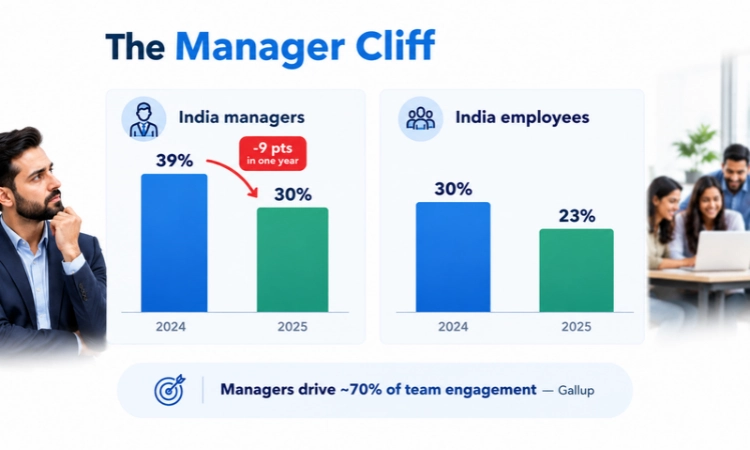
India’s engagement fell to its lowest level in four years in 2025, and Gallup puts the cost of that disengagement at about $351 billion (roughly ₹32.7 lakh crore) a year in lost productivity, close to 9% of GDP. The sharper story is in the manager row.
Metric (Gallup, 2025 data) | India | Global | What it means for you |
|---|---|---|---|
Employees engaged at work | 23% (down from 30% in 2024) | 20% (lowest since 2020) | 3 in 4 people on your floor are doing the job, not owning it |
Manager engagement | 30% (down from 39%) | 22% (down from 27%) | Your team leads dropped faster than your team members |
Individual-contributor engagement | 19% (down from 24%) | 19% | The gap between leaders and teams is closing from the wrong side |
Employees who felt stress “a lot” yesterday | 28% | 40% | Stress is lower in India, but anger (31%) and sadness (36%) are higher than global |
Employees thriving in life overall | 17% | 34% | Half the global rate; wellbeing is a retention lever, not an HR slogan |
Say it is a good time to find a job | 53% | 52% | Your disengaged people believe they can leave, and many intend to |
Sources: Gallup, State of the Global Workplace 2026 press release · Gallup India country-level data · Gallup, Quiet Quitting Is on the Rise in India
The practical read: if your managers are disengaged, no incentive scheme reaches the team through them. Any intervention that does not first reach the leader layer is leaking.
What a corporate motivational speaker actually does for leaders and owners

A good session is not a pep talk. It is a structured reset of five things that quietly decide whether a team hits its number.
- It re-engages the manager layer first. Gallup’s research on manager coaching programmes found participants reported up to 22% higher engagement, their teams up to 18% higher, and manager performance metrics improved 20–28%. A speaker who addresses team leads directly, not just the floor, is working on the highest-leverage group in the room.
- It converts “targets assigned” into “targets owned”. Most teams know the number. What they lack is a personal reason to chase it. Speakers who work from stories of first-generation founders, salespeople who started with nothing, and leaders who rebuilt after failure give the audience a reference point they identify with. Ownership follows identification.
- It gives business owners a second voice. Founders repeat the same message for years and watch it lose power. When an outside speaker says it, the team hears it fresh, and the founder’s credibility rises because an expert is agreeing with them.
- It fixes the belief ceiling before the skill gap. Sales training teaches technique. Technique fails when the salesperson does not believe the customer will buy. Motivational sessions built around belief, consistency and discipline address the layer below skill, which is why many companies pair a keynote with a half-day workshop.
- It creates a shared vocabulary. Six months later, the line a speaker used on stage is still being repeated in review meetings. That shared language is what makes culture stick, and it is why the session should be recorded and clipped for internal use.
Which event format fits which problem
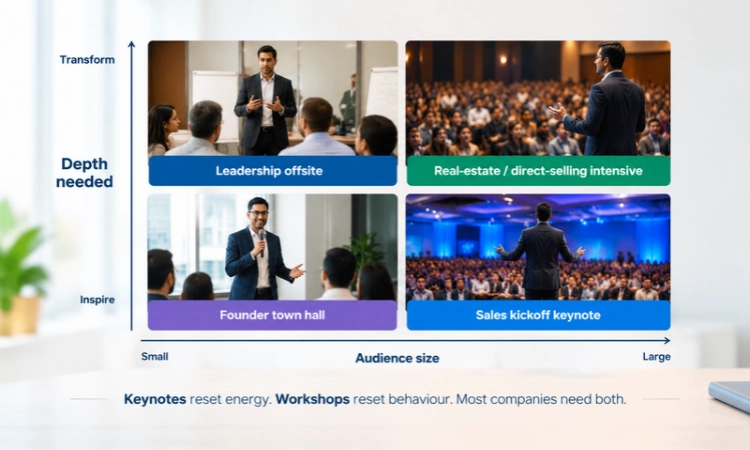
The format should follow the business problem, not the calendar. Corporate events in India broadly fall into two buckets: performance events (kickoffs, offsites, partner meets) and corporate bonding events (team outings, annual days, founder’s-day celebrations). A speaker works in both, but the brief is different. This is how most Indian corporates use one today.
Event type | Best for | Typical duration | Audience size | Business outcome to measure |
|---|---|---|---|---|
Sales kickoff / annual conference keynote | New targets, new financial year, post-restructuring reset | 60–90 min | 200–2,000 | Pipeline activity in the following 30 days; attendance at follow-up calls |
Leadership offsite session | Team leads and mid-managers losing engagement, second-line leadership building | Half day | 20–80 | Manager engagement pulse score, delegation rate, attrition in their teams |
Corporate bonding events (team outing, annual day, founder’s day) | Teams that work in silos, post-merger integration, hybrid teams that rarely meet | 45–60 min within a longer day | 50–1,000 | Cross-team collaboration score, eNPS, internal referrals in the next quarter |
Dealer / channel partner meet | Distributors, franchisees, agents who do not report to you | 45–60 min | 100–1,500 | Partner activation, order frequency next quarter |
Real estate or direct-selling team event | High-churn, high-rejection sales roles | 2–4 hrs | 300–5,000 | Site visits booked, retention at 90 days |
Founder-led town hall with guest speaker | Culture reset, post-layoff morale | 45 min + Q&A | 50–500 | eNPS, internal referral rate |
A word on corporate bonding events specifically, because this is where most companies waste the speaker. Games, a resort and a DJ build familiarity; they do not build trust. The 45 minutes that actually bond a team is when people hear a story that makes them see their colleague’s struggle differently. Put the speaker before the fun, not after dinner when half the room is on their phones, and ask for a session built around shared goals rather than individual hustle. That one scheduling change decides whether the outing is remembered as a trip or as a turning point.
A realistic planning note: keynotes are booked 6–10 weeks ahead for Q4 and new-year kickoffs, and the best speakers’ January–March calendars fill by November. If your financial-year kickoff is in April, lock the date before Diwali.
A working example: how Sonu Sharma runs a corporate session
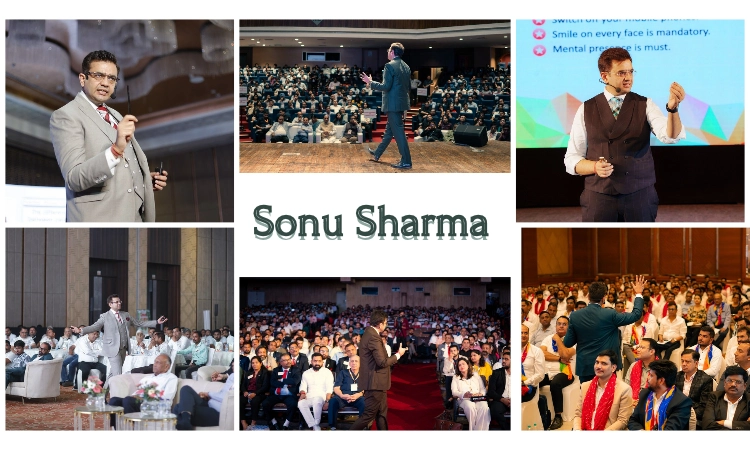
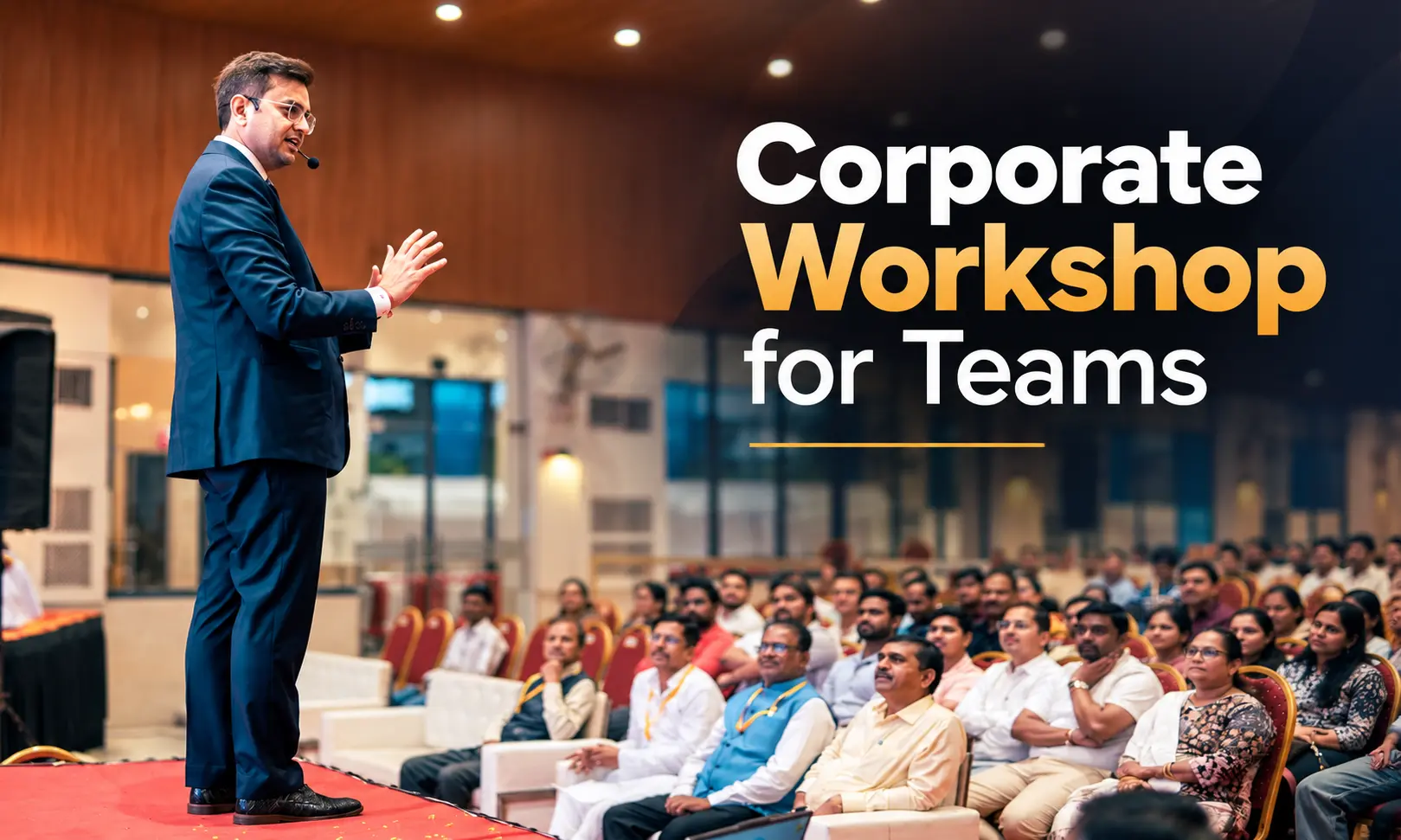
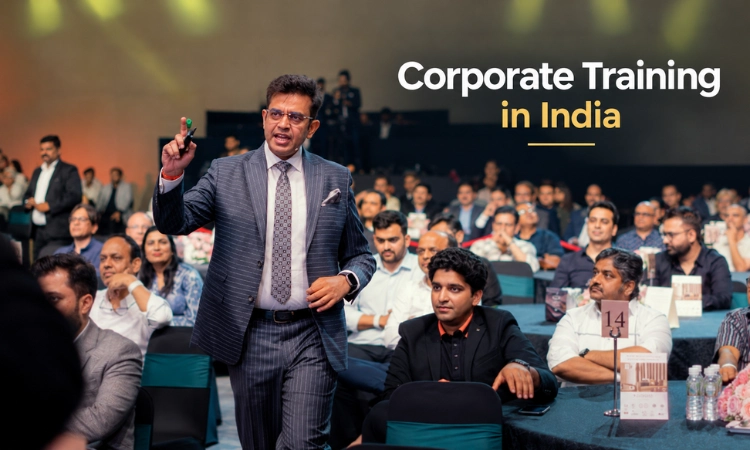
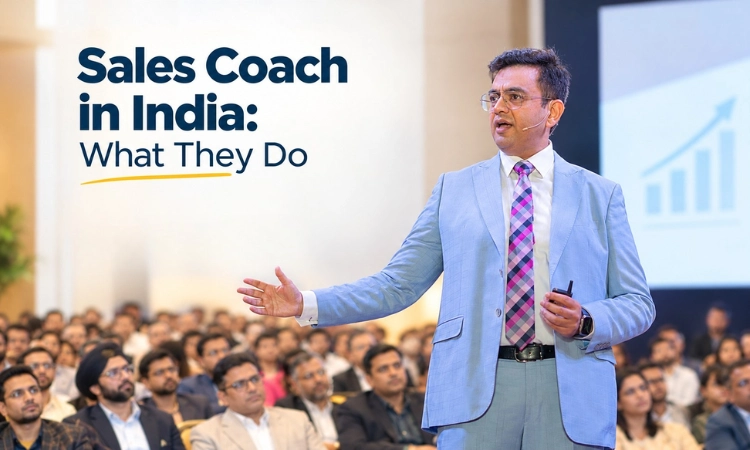
To make this concrete, here is how one of India’s most-booked corporate speakers structures an engagement. Sonu Sharma has delivered sessions for 250+ corporates including Maruti Suzuki, Aditya Birla Group, ICICI, HP, Abbott, Adani Group, Jindal Steel & Power, Berger Paints, Mankind Pharma and Aakash BYJU’S, and reaches 30M+ followers and 13M+ YouTube subscribers, which matters because most of your younger team already knows his voice before he walks in.
What separates his corporate work from a generic keynote:
- No two sessions share a script. A sales floor, a leadership team and a dealer meet each get a different conversation, built on a pre-event call with the organiser about the actual problem (missed targets, attrition, founder dependency).
- Delivered in the language teams think in. Sessions are run in Hindi–English the way Indian offices actually talk, which is why the lines get repeated in review meetings months later.
- Belief → clarity → action → consistency. The framework behind his motivational sessions and corporate training is built so that the energy in the hall becomes a daily habit on the floor.
- Formats that match the table above. 60–90 minute keynotes, half-day leadership workshops, multi-day intensives, and dedicated sales and real estate programmes for high-rejection roles.
How to choose a speaker and measure the return
Use this before you sign anyone. Score each row 1–5; anything under 18/25 is a risk.
Selection criterion | What to check | Red flag |
|---|---|---|
Relevance to your industry | Has spoken to sales, manufacturing, pharma, BFSI or real estate teams like yours | Only college or public-event footage |
Pre-event discovery | Insists on a briefing call with the organiser or founder | Sends a fixed deck, no questions asked |
Language and audience fit | Comfortable in the Hindi–English mix your floor uses | Only polished English keynote style |
Follow-through options | Offers a workshop, recording rights, or 30-day follow-up content | Session ends when the applause ends |
Social proof | Named corporate clients, verifiable testimonials, visible audience reach | Generic “Fortune 500” claims, no names |
A simple ROI model. Take a 200-person sales team with an average monthly revenue contribution of ₹2 lakh per person (₹4 crore a month). Gallup’s meta-analysis links engagement to productivity and sales; if a session and its follow-up lift output by even 3% for one quarter, that is ₹36 lakh of incremental revenue against a speaker fee that is typically a fraction of it. Attrition is the second line: replacing one sales rep in India costs roughly 3–6 months of salary in hiring, training and lost pipeline, so holding on to five people who were planning to leave pays for the event on its own.
Frequently asked questions
How much does a corporate motivational speaker cost in India?
Fees vary widely with reach, format and duration. A 60–90 minute keynote from a nationally known speaker sits in a different band from a half-day workshop or a multi-city tour. Share your date, city, audience size and goal and you will get a precise quote; most organisers budget it as a fraction of the revenue or attrition impact described above.
How far in advance should we book?
6–10 weeks for a standard keynote; 3–4 months for January–March and new-financial-year kickoffs, when calendars fill fastest.
Can the session be customised to our industry and targets?
Yes. Expect a pre-event briefing call. Sessions for pharma field forces, real estate teams, BFSI, manufacturing dealers and direct-selling networks each use different stories and examples.
Do you offer sessions in Hindi?
Sessions are delivered in the Hindi–English mix most Indian teams use, which is the main reason the content gets repeated on the floor afterwards.
Will we get a recording?
Recording and internal-use rights can be arranged at booking. Clips are useful for onboarding and quarterly refreshers.
Does a motivational speaker make sense for corporate bonding events, not just sales kickoffs?
Yes, and often more so. Bonding events gather people who rarely sit in one room; a 45-minute session built around shared goals does more for trust than another round of team games. Schedule it before the activities, not after dinner.
Book Sonu Sharma for your next corporate event
If your team leads are tired, your targets feel assigned rather than owned, or your next kickoff needs more than a slide deck, this is the moment to plan it.
Share your event brief and the team will call you back personally:
- Book online: sonusharma.in/contact — tell us the event type, date, city, audience size and the one outcome you want
- Call: +91 91513 13101 for a private discussion
- Email: office@sonusharma.in
Upcoming public events, including the Real Estate Gamechanger series, are listed on the Events page.