




Ask ten sales heads whether their team has been trained, and nine will say yes. Ask the same ten whether the team hit its target last year, and the room goes quiet.
The numbers back that silence. In Salesforce’s State of Sales research, 84% of sales reps said they missed quota the previous year, and 67% did not expect to hit it in the current one. Training is happening almost everywhere. Results are not.
That gap is why this guide exists. India has no shortage of sales training programs. You can book a two-hour webinar, a two-day offsite or a six-month academy by this evening. What is in short supply is a clear way to tell a program that changes what your team does on Monday morning from one that produces a good group photo and nothing else.
This guide covers the types of sales training programs, what a serious curriculum contains, how to choose one, and how to measure whether it paid for itself.
Key takeaways
- Most sales teams are trained, yet most still miss target. The problem is usually the design of the program, not the absence of one.
- Buyers now give sellers very little time, so skill in the conversation matters more than product knowledge.
- The best sales training programs combine skill, mindset and manager follow-up over at least 90 days.
- Measure training on revenue per rep and conversion rate, never on feedback forms.
What Are Sales Training Programs?
Sales training programs are structured learning plans that build the skills, product knowledge and mindset a salesperson needs to find prospects, run buying conversations and close deals. They range from one-day workshops to year-long academies, and are delivered in person, online or as a mix of both.
A program is different from a one-off motivational session. A session lifts energy for a week. A program sets a starting point, teaches a method, makes people practise it and then checks whether the numbers moved. Good sales training for employees needs both the energy and the system.
Why Sales Training Programs Matter: What the Numbers Say
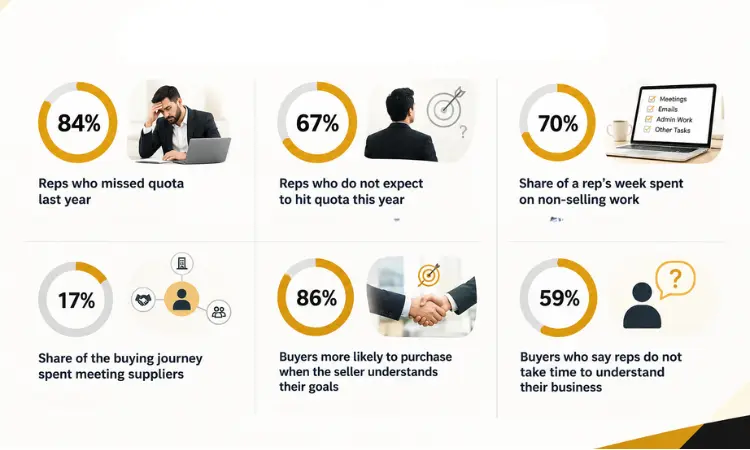
Selling has become harder in the last few years, and the pressure shows up in the numbers.
What changed | The number | Source |
|---|---|---|
Reps who missed quota last year | 84% | |
Reps who do not expect to hit quota this year | 67% | Salesforce State of Sales |
Share of a rep’s week spent on non-selling work | 70% | Salesforce State of Sales |
Share of the buying journey spent meeting suppliers | 17% | |
Buyers more likely to purchase when the seller understands their goals | 86% | Salesforce State of Sales |
Buyers who say reps do not take time to understand their business | 59% | Salesforce State of Sales |
Read the fourth row again. Gartner found that B2B buyers spend only 17% of their buying time with suppliers. If three vendors are in the race, each one gets five or six percent. Your salesperson may have twenty minutes to earn a deal that took the customer three months to think about.
Now put the last two rows next to each other. Buyers say they are far more likely to purchase from someone who understands their goals, and more than half say sellers do not bother to find out. That is not a product problem or a pricing problem. It is a skill problem, and skill is what training exists to fix.
The India picture
India adds its own pressure. The direct selling industry alone reached ₹23,021 crore in FY 2024-25, with 93.2 lakh active direct sellers, according to the IDSA and Ipsos annual report. Women now make up 48% of that workforce, up from 44% a year earlier.
Many of those 93 lakh people have never sat through a formal sales course. They learned from an upline, a senior or a YouTube video. This is why demand for sales training programs in India has moved beyond large corporates to distributors, dealers, insurance advisors and first-time entrepreneurs in tier-2 and tier-3 cities.
Types of Sales Training Programs
No single program suits every team. A pharma field force, a real estate channel partner network and a SaaS inside-sales desk have little in common beyond the word “target”. Start by matching the type of training to the kind of selling your people do.
Type of program | Who it is for | Core focus | Usual length |
|---|---|---|---|
Foundation / induction | New hires, freshers, career switchers | Sales process, product pitch, basic objection handling | 3 to 10 days |
B2B sales training | Enterprise and key-account sellers | Discovery, multi-stakeholder deals, proposals, negotiation | 2 to 5 days plus coaching |
Field and channel sales | FMCG, pharma, paints, cement, dealer networks | Beat planning, dealer relationships, range selling, collections | 1 to 3 days per quarter |
Direct selling and network marketing | Distributors, advisors, team leaders | Prospecting, invitation, presentation, follow-up, team duplication | 1-day events plus weekly follow-up |
Inside sales and tele-sales | Call centre and digital sales desks | Call opening, qualification, closing on the phone or video | 5 to 15 days |
Sales leadership | Team leaders, area and regional managers | Coaching, pipeline reviews, hiring, forecasting | 2 to 4 days plus monthly clinics |
Sales mindset and motivation | Whole sales force, annual meets, kick-offs | Belief, discipline, rejection handling, goal setting | Half day to 1 day |
In-person, online or blended: which format works?
Format decides how much of the training survives the trip back to the office. Memory research going back to Hermann Ebbinghaus shows that people lose most of what they hear once unless they revisit it, so the format has to build in repetition.
Format | Best for | Strength | Weak point |
|---|---|---|---|
In-person workshop | Annual meets, launches, teams that need energy and bonding | Role plays, live feedback, full attention | Travel cost; fades quickly without follow-up |
Live virtual sessions | Spread-out teams, weekly skill drills | Low cost per head, easy to repeat | Attention drops after about an hour |
Self-paced sales training courses | Product knowledge, onboarding at scale | Learn any time, consistent content | Low completion without a manager pushing |
Blended (workshop + online + coaching) | Any team that wants a lasting change | Repetition is built in | Needs planning and manager time |
For most Indian sales teams, blended wins. Use a strong in-person day to open minds, short online sales training sessions to drill one skill a week, and manager coaching to make it stick.
What a Strong Sales Training Curriculum Covers
Before you sign anything, ask for the module list. A complete set of sales training topics looks like this.
Module | What the team learns | The number it should move |
|---|---|---|
1. Prospecting | Building a daily list, referrals, social selling, cold outreach | New conversations per week |
2. Opening and rapport | First 60 seconds, tone, listening before pitching | Meeting-to-second-meeting rate |
3. Discovery | Asking questions that uncover the real need and budget | Qualified opportunities |
4. Presentation | Linking features to the customer’s goal, storytelling | Proposal acceptance rate |
5. Objection handling | Price, timing, trust and competitor objections | Lost-deal ratio |
6. Closing | Asking for the order, trial closes, handling silence | Conversion rate |
7. Follow-up and referrals | Follow-up rhythm, after-sales contact, asking for referrals | Repeat and referral business |
8. Self-management | Goal setting, daily discipline, handling rejection | Activity consistency |
Why mindset sits inside the curriculum, not outside it
Module 8 is the one most companies cut to save time. It is also the reason the other seven fail. A salesperson who knows the closing technique but dreads the tenth “no” of the day will not use it. In our workshops, the people who improve fastest are rarely the ones with the best script. They are the ones who keep making calls after a bad morning.
How to Choose the Best Sales Training Program for Your Team
Use this seven-point check when you compare providers. If a provider cannot answer four of the seven, keep looking.
- Do they diagnose before they prescribe: A good trainer asks for your funnel numbers, listens to calls or joins field visits before designing anything.
- Is the content built for your industry: Selling a term plan and selling TMT bars need different examples, objections and role plays.
- Does the trainer speak your team’s language: In India this is literal. A field force in Kanpur or Indore absorbs far more from sales training in Hindi than from borrowed American slides.
- How much of the day is practice: Look for at least 40% of the time in role plays, live calls or exercises.
- What happens after day one: Ask for the 30, 60 and 90-day follow-up plan in writing.
- Are managers trained too: If managers do not coach the new method, the old habits return within weeks.
- Which numbers will they be judged on: Agree on two or three metrics before the program starts.
How Sonu Sharma Runs Corporate Sales Training Programs
Sonu Sharma is the founder of Dynamic India Group, an author, business consultant and one of India’s most followed speakers on sales and personal development. He has spent more than 23+ years studying how selling works on the ground in India, with a deep base in the direct sales industry.
Credential | Figure |
|---|---|
YouTube subscribers | 13 million |
People addressed in live seminars | 20 lakh+ |
Years of sales and direct selling research | 23 Years |
Corporate clients | Abbott, Mankind Pharma, UltraTech Cement, Jindal Steel, Berger Paints |
His corporate sales training programs are built on three ideas.
- Mindset before method. Every program opens by working on belief, self-image and the fear of rejection. Technique is taught only after the room is ready to use it.
- Stories people repeat. Frameworks are taught through real situations in Hindi and English, so a salesperson in a dealer’s shop can recall them without notes.
- Customised to the business. Content, examples and role plays are rebuilt for each client’s industry, product and customer, whether that is BFSI, pharma, building materials, real estate or direct selling.
Ready to Build a High-Performing Team?
Share your team size, industry, and goals, and our team will help you plan the right sales or corporate training program.
How to Measure the ROI of Sales Training
A feedback score of 4.8 out of 5 tells you the team enjoyed the day. It tells you nothing about revenue. Measure the program on money.
Training ROI (%) = (Extra gross profit from the trained team – Total training cost)
/ Total training cost x 100
A worked example (illustrative numbers)
Item | Value |
|---|---|
Sales reps trained | 40 |
Total program cost | ₹6,00,000 |
Average monthly sales per rep before training | ₹10,00,000 |
Lift in sales per rep after training | 6% (₹60,000 a month) |
Extra revenue over 6 months (40 × ₹60,000 × 6) | ₹1,44,00,000 |
Extra gross profit at a 25% margin | ₹36,00,000 |
ROI = (36,00,000 – 6,00,000) / 6,00,000 × 100 | 500% |
A six percent lift is a modest target. The point of the example is that even a small, sustained change in conversion pays for a well-run program several times over. To make the number honest, compare the trained group with a similar untrained group over the same months.
A 90-day rollout plan
Phase | Days | What happens | Owner |
|---|---|---|---|
Diagnose | 1 to 15 | Pull funnel data, listen to calls, join field visits, fix 2 to 3 target metrics | Sales head + trainer |
Ignite | 16 to 20 | In-person workshop: mindset, core method, role plays | Trainer |
Drill | 21 to 60 | One skill per week in 45-minute live sessions; daily activity tracker | Managers |
Coach | 61 to 80 | Managers sit in on calls or visits and give feedback on one skill at a time | Managers |
Review | 81 to 90 | Compare metrics with the baseline, recognise top improvers, plan the next quarter | Sales head |
Frequently Asked Questions
What is a sales training program?
A sales training program is a structured plan that teaches salespeople how to prospect, present, handle objections and close, and builds the mindset to do it consistently. It includes practice and follow-up, which separates it from a single talk.
How long should a sales training program be?
Plan for at least 90 days. A one or two-day workshop starts the change, but skills settle only with weekly practice and manager coaching over the following two to three months.
Which is the best sales training program in India?
The best sales training program is the one built around your industry, your team’s language and your funnel numbers. Compare providers on diagnosis, customisation, practice time, follow-up and the metrics they agree to be judged on.
Are online sales training programs effective?
Yes, for knowledge and weekly skill drills. Online sessions work best when they are short, live and paired with manager coaching. For mindset shifts and role plays, an in-person day is still more effective.
What does corporate sales training cost in India?
Cost depends on the trainer’s profile, team size, days of delivery, customisation and follow-up. Ask every provider for an all-inclusive quote and judge it against the expected lift in revenue per rep, not against the day rate alone.
Does Sonu Sharma conduct sales training in Hindi?
Yes. Sonu Sharma delivers sales training programs in Hindi and English, customised for corporates, dealer networks and direct selling organisations across India.
Conclusion
Sales targets rarely fail for lack of effort. They fail because the team was never shown a better way to have the conversation, or was shown once and never followed up. Choose sales training programs that diagnose first, practise hard and measure in rupees, and the results will show up where they count.