






Ever wondered why some sales teams close deal after deal while others keep missing targets month after month? Most of the time, the difference isn’t luck or some secret market advantage. It comes down to one thing that a lot of businesses still treat as optional: sales team training.
Sales isn’t a “figure it out as you go” job anymore, not in 2026 at least. Buyers do their own research now; they compare vendors before a rep even picks up the phone, and they expect conversations that actually add value. If your sales force isn’t equipped for that reality, you’re going to lose deals to competitors who trained theirs better.
This blog breaks down what sales team training actually means, why it matters right now more than any other time, and the ten concrete ways it drives business growth. We’ll also cover the skills a good training program should include, how often training should happen, and some common mistakes companies make when they try to build one.
What Is Sales Team Training?
Sales team training, put simply, is a structured way of teaching reps the skills, knowledge, and techniques they need in order to sell more effectively and more consistently. What it isn’t is a single workshop where someone talks at your team for an hour and everyone calls it a day. Real training covers things like:
- Product and service knowledge
- Communication and negotiation skills
- Objection handling
- Using CRM tools properly
- Understanding buyer psychology and the sales pipeline
Some companies run this in-house through a dedicated sales coaching program, others bring in outside experts who specialise in sales performance training. Either way works, as long as it’s ongoing rather than a one-off event that everyone forgets about within a month.
Why Sales Training Matters More Than Ever
Sales has changed shape a lot in the last few years, and the pace of that change hasn’t slowed down. According to HubSpot’s 2025 State of Sales Report, close to 60% of sales teams are on track to meet or surpass their revenue targets, and roughly 68% say lead quality has actually improved year over year. That’s a decent number, but it also means a good chunk of teams are still falling short, and better lead quality alone isn’t closing deals without the right skills behind it.
Digital selling has taken over too. HubSpot’s 2025 Sales Trends Report shows social media now pulls in response rates near 42%, almost double what email manages at around 26%, and a good third of reps say their best leads now come from social channels. If your reps were trained five years ago on cold-calling scripts and nothing else, they’re probably missing a huge chunk of opportunity sitting right there on LinkedIn.
Speaking of LinkedIn, businesses that lean into social selling see real results too. LinkedIn’s own research points to social-selling businesses outperforming those that don’t by a wide margin, with companies that prioritise it being noticeably more likely to hit their sales quota. That’s not a small edge.
There’s also a productivity angle worth mentioning. Research from the Sales Management Association found that companies using sales technology well were significantly more efficient at sales development and training compared to companies that don’t use it effectively. And the payoff on training spend itself is genuinely strong too, some estimates put the return at over four dollars for every single dollar spent on sales training.
So yeah. The market has moved. Buyers research before they even talk to a rep, they expect relevant conversations, and reps who aren’t trained for this new reality get left behind fast. That’s the whole point of investing in professional sales training right now, not later.
Also Read: How to Handle Sales Rejections
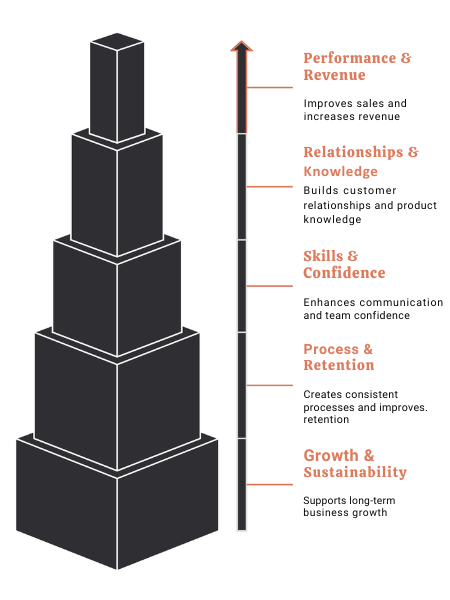
10 Benefits of Sales Team Training
1. Improves Sales Performance

This one’s the obvious one, but it’s obvious for a reason. Trained reps simply perform better. They know how to structure a pitch, read buying signals, and move a prospect through the funnel without fumbling around. Sales performance training gives your team a repeatable playbook instead of leaving everyone to wing it based on gut instinct.
Untrained reps often rely on whatever worked for them once, and they keep doing it even when it stops working. Training breaks that habit and replaces it with methods that are actually tested and proven.
2. Increases Revenue

More skill tends to lead to more closed deals. And more closed deals lead to more revenue. Nothing complicated about that logic, yet a surprising number of businesses still fail to see how directly training connects to the bottom line.
Consider a few things:
- Better qualifications mean fewer hours wasted chasing dead-end leads
- Stronger closing techniques translate into higher conversion rates
- Sharper upselling and cross-selling skills push average deal sizes up
Push sales productivity higher, and revenue has a way of following. Few areas of business spending offer a return this measurable.
3. Builds Stronger Customer Relationships

Selling was never supposed to be about closing one deal and jumping straight to the next name on a list. Real selling builds relationships, the kind that generate repeat business and referrals for years. Trained reps get this instinctively. Listening properly, asking the right questions, following up in a way that doesn’t feel pushy or scripted, all of it comes from training.
Solid customer relationship habits get built in training too. Tracking client preferences, timing a follow-up so it lands right, and knowing when backing off is smarter than pushing forward. Customers notice the difference, almost always, between a rep who genuinely wants to understand them and one who’s just chasing a number.
4. Enhances Product Knowledge

Nobody sells what they don’t understand. That much is obvious. And yet plenty of reps carry quiet gaps in product knowledge that end up killing deals without anyone noticing why. A customer asks something technical, the rep stumbles or gives a vague non-answer, and trust takes a hit right there.
Good training closes that gap. Every rep should:
- Know the product inside and out, features, limitations, every use case
- Understand exactly how it stacks up against competitors, so “why you and not them” gets answered with confidence
- Turn features into benefits naturally, since customers care about outcomes far more than specs
5. Improves Communication Skills

A lot of selling really just comes down to communication. Can the rep explain things clearly? Can they read tone and body language? Can they adjust their pitch depending on who they’re talking to? Sales skills training puts a heavy focus on this because it affects literally every stage of the sales process.
Reps who communicate well tend to build rapport faster, they explain complex offerings in simple terms, and they know how to steer a conversation without making it feel forced. This skill alone can be the difference between a stalled deal and a closed one.
6. Increases Team Confidence

Nobody walks into a sales career already confident. That gets built, slowly, through practice and preparation. Reps who go into calls unsure of themselves give it away almost immediately, and prospects sense that hesitation faster than most people realise.
What training does is give reps enough repetition to walk into any conversation already feeling ready. Role-play, mock objections, product quizzes, small drills like these build something close to muscle memory. And that muscle memory shows up as real confidence once the calls go live. Confident reps simply close more. There isn’t much more to it than that.
7. Helps Handle Objections Effectively

Objections show up in every sales conversation eventually. “Too expensive.” “We’re already with a competitor.” “Not the right time.” Reps without training tend to freeze or get defensive the moment this happens, and that’s usually where the deal quietly dies.
A strong coaching program teaches reps to view objections almost as openings rather than obstacles. Frameworks get taught for:
- Acknowledging the concern without getting defensive about it
- Asking clarifying questions to get at the real hesitation underneath
- Reframing around value instead of getting stuck on price
- Recognising when to keep pushing and when it’s time to let go
8. Creates a Consistent Sales Process

Left to their own devices, every rep develops their own approach, and results become unpredictable fast. One rep shines, another barely gets by, and nothing ties the two together. Training standardises things so quality stops depending entirely on which rep happens to pick up the call.
That consistency makes onboarding new hires a lot smoother too, and it makes tracking what actually works possible, and scaling the whole sales operation without things falling apart. A clear methodology behind a training program also gives managers something solid to measure against.
9. Improves Employee Retention
Sales roles see notoriously high turnover, and a big chunk of that comes down to reps feeling unsupported, stuck, without any real path forward. Training shifts that. People who sense the company is actually investing in their growth tend to stay a lot longer.
It helps in a few other ways as well:
- Burnout drops, since trained reps hit fewer frustrating walls
- Career paths within sales become clearer and more visible
- A sense of belonging builds, something bigger than just chasing quota
Losing a trained rep almost always costs more than the training itself would have, once you factor in lost deals, ramp-up time for whoever replaces them, and the institutional knowledge that just walks out the door.
10. Supports Long-Term Business Growth
All of the above points feed into this last one. Better performance, higher revenue, stronger relationships, more confident reps, lower turnover, all of it compounds over time into sustainable growth. A business that treats sales team training as an ongoing investment rather than a checkbox tends to outpace competitors who don’t, especially over a multi-year horizon.
Companies that formalise their enablement efforts also see it reflected in hard numbers; organisations with structured programs report higher win rates on forecasted deals, compared to teams without a formal program. That gap widens every quarter it’s left untouched.
Also Read: Benefits of Corporate Training Programs
Key Skills Every Sales Training Program Should Include
Not every training program is built the same, and some cover way more ground than others. At minimum, a solid program should include:
- Prospecting and lead qualification: Knowing where to look and who’s actually worth pursuing.
- Communication and active listening: The foundation of every good sales conversation.
- Objection handling: Because objections aren’t going away, ever.
- Negotiation tactics: Closing on terms that work for both sides.
- CRM and tech tool proficiency: Since most modern selling happens through some kind of software.
- Product and industry knowledge: So reps sound credible, not scripted.
- Emotional intelligence: Reading the room, adjusting tone, picking up on hesitation.
How Often Should Sales Teams Be Trained?
This is where a lot of businesses stumble. Training gets treated like a one-time event, a big kickoff, and then silence for the rest of the year. Skill retention doesn’t work that way.
A better rhythm usually looks something like this:
- Onboarding spread across the first few weeks for new hires, rather than crammed into a single day
- Monthly or quarterly refreshers that reinforce core skills and introduce new ones
- Ongoing coaching through regular one-on-ones or call reviews, not just group sessions
- Annual deep-dives for bigger overhauls, particularly when the market shifts
No single frequency fits every business. It comes down to team size, how complex the industry is, how fast the market moves. Still, one rule holds pretty firmly across the board: continuous beats occasional, every time.
How to Measure the Success of Sales Team Training?
Training without measurement is really just guessing. Businesses need a way to confirm it’s actually working, and a handful of methods tend to hold up well:
- Track win rates before and after training. A climbing win rate says a lot on its own.
- Watch average deal size. Trained reps tend to close bigger deals through sharper upselling.
- Keep an eye on quota attainment. Are more reps consistently hitting their numbers?
- Measure ramp-up time for new hires. Good training should shrink the time it takes them to become productive.
- Gather qualitative feedback from both reps and managers around confidence and remaining skill gaps.
- Check customer satisfaction scores. Better sales conversations tend to leave customers happier well after the sale closes.
None of these numbers says much sitting alone. The trend across time is what actually tells the story.
Common Mistakes Businesses Make in Sales Training
A handful of mistakes keep resurfacing, regardless of industry:
- Treating training like a one-time event instead of something ongoing
- Skipping the follow-up coaching, so nothing from the training actually sticks
- Leaning on generic content that ignores the specific product, industry, or buyer
- Skipping measurement entirely, leaving no way to know if any of it worked
- Overlooking experienced reps, as if only new hires need the work
- Underinvesting in practice, all theory and barely any role-play or real scenario work
Avoid these few missteps, and the value a business pulls out of its training spend changes dramatically.
Conclusion
Training a sales team isn’t optional anymore. It has quietly turned into one of the core things that separates businesses that grow from businesses that stall. Better performance, stronger revenue, deeper customer relationships, reps who actually stick around longer, all of it tends to show up once a company treats training as something ongoing rather than a one-time event.
Buyers are getting sharper every year, and the market doesn’t sit still for anyone. Companies that keep investing in their sales team’s growth are usually the ones pulling ahead of the pack. For those wanting a program built around their specific team, working with the Best sales trainer in India or looking into structured Corporate Training Programs can be a good place to start. Anyone wanting the bigger picture first should probably read up on the general Benefits of Corporate Training before zooming in on sales-specific coaching. And getting in touch with the Best corporate trainer in India for a proper needs assessment tends to be a smart early step as well.
Frequently Asked Questions
1. What is sales team training?
Sales team training is basically a structured approach to teaching reps the skills, techniques, and product knowledge they need in order to sell effectively. It covers a lot of ground: communication, objection handling, CRM tools, negotiation. Most companies don’t treat it as a single event. It’s usually ongoing coaching, spread out over time rather than crammed into one day.
2. Why is sales team training important for businesses?
It matters because it touches three things at once, revenue, customer relationships, and retention. A well-trained rep closes more deals. They handle pushback with more confidence. And they tend to build relationships that actually hold up over time, not just one-off transactions. Add all that together and you get growth that’s measurable, not just theoretical.
3. What skills should be included in a sales training program?
There’s a baseline list most programs should cover, prospecting, communication, objection handling, negotiation, CRM proficiency, and solid product knowledge. Emotional intelligence belongs in there too, and it’s often underrated. How much weight each skill gets really comes down to the industry, and how complex whatever’s being sold actually is.
4. Does sales training improve customer satisfaction?
In most cases, yes. When a rep listens well, explains things clearly, and actually knows their product, the buying experience just feels smoother. More trustworthy too. And that effect doesn’t stop once the deal closes, it tends to stick around, shaping how the customer feels about the company well after the sale.
5. Is sales training useful for experienced sales professionals?
It does, and a lot of people assume otherwise. Even reps who’ve been doing this for years benefit from refreshers, new techniques, and staying in tune with how buyer behaviour keeps shifting. Skip training for your experienced staff long enough, and their skills tend to fade without anyone really noticing.