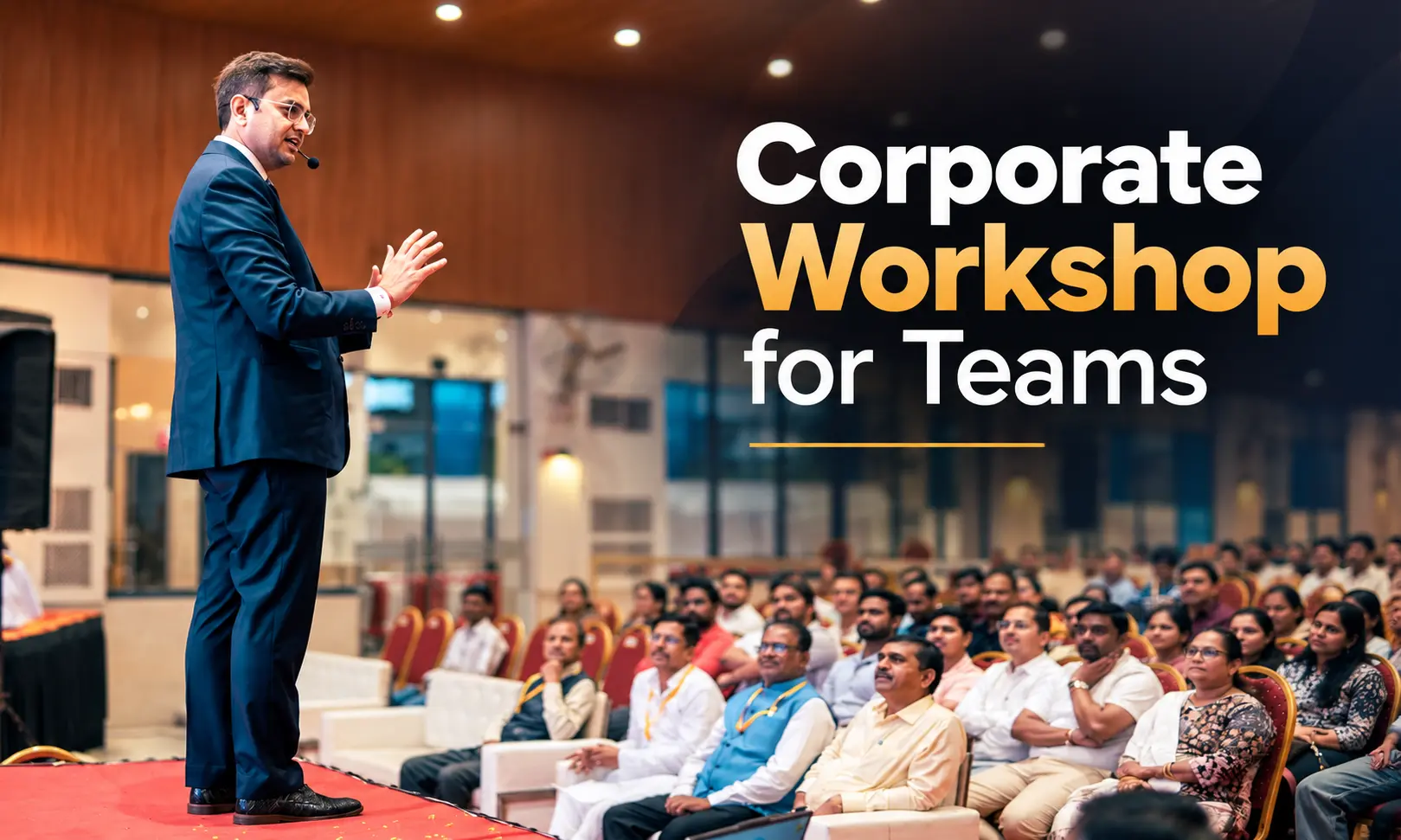






Every April, the same thing happens in hundreds of Indian companies. Targets go up by 20 or 30 percent. The team stays the same. Somebody in the review meeting says, “Let’s get them trained,” and a two-day workshop is booked for the annual sales meet.
The workshop goes well. People laugh, take notes and post photos. By June, the numbers look exactly as they did in March.
The issue is rarely the trainer or the team. Sales training for corporate teams fails when it is treated as an event instead of a system. This guide explains how to design it so the change survives the trip back to the territory. If you are still comparing options, start with our complete guide to sales training programs.
Why Corporate Sales Teams Need Their Own Approach
Training one ambitious individual is simple. Training a corporate team of 50 or 500 is a different job, for three reasons.
The team is not one audience. A fresher, a ten-year territory veteran and a regional manager sit in the same hall with completely different problems.
The process already exists. Corporate teams work inside a CRM, a pricing policy, an approval chain and a reporting format. Training that ignores these gets ignored in return.
The customer has less time than ever. Gartner’s research found that B2B buyers spend only 17% of their buying journey meeting suppliers, and that share is split between every vendor in the race. A corporate salesperson gets a small window, and has to be good inside it.
Add the pressure on the seller’s own time. In Salesforce’s State of Sales research, reps reported spending 70% of their week on non-selling work, and 84% said they missed quota the previous year. A corporate team does not need more information. It needs sharper use of the few selling hours it has. This is the brief every corporate trainer should work to.
What to Teach: Training Needs by Role
Split the team into four groups before you plan a single session.
Role | Biggest gap | What to train | Metric to track |
|---|---|---|---|
New hires (0 to 1 year) | No method, fear of rejection | Sales process, product pitch, basic objection handling, daily discipline | Calls and meetings per week |
Field and territory executives | Selling on relationship and discount alone | Discovery questions, value selling, range selling, negotiation without discount | Average order value, conversion rate |
Key account managers | Single contact in the account | Mapping decision makers, proposals, account planning, cross-selling | Revenue per account, wallet share |
Sales managers | Reviewing numbers instead of coaching people | Coaching conversations, pipeline reviews, hiring, joint field work | Team quota attainment, attrition |
If the budget allows only one group, train the managers first. A manager who coaches well multiplies every rupee spent on the team below. A manager who does not will undo the workshop within a month, usually with one sentence: That is fine for the classroom, here we do it my way.
How to Run Sales Training for Corporate Teams: Five Steps
- Diagnose with data. Pull three months of funnel numbers: leads, meetings, proposals, closures. Find the stage where most deals die. That stage is your syllabus. Listen to ten recorded calls or join five field visits before finalising anything.
- Fix two or three target metrics. Write them down before the workshop, for example “meeting-to-proposal rate from 30% to 40% in one quarter”. Training without a number becomes entertainment.
- Open with a strong in-person day. Use it for what a screen cannot do: shifting belief, building energy and practising live. At least 40% of the day should be role plays on your own products and your own customer objections.
- Drill and coach for 60 days. One skill a week in a 45-minute session, followed by managers observing real calls. This is where a workshop turns into a habit, and where an experienced sales coach in India adds the most value.
- Review in rupees. At day 90, compare the target metrics with the baseline and with an untrained group if you have one. Our guide on how to measure training ROI has the formula and a worked example.
Choosing the format
Team situation | Format that fits |
|---|---|
Annual sales meet, product launch, low morale | One in-person day with a high-energy trainer |
Team spread across many cities | Live virtual sessions of 45 to 60 minutes, weekly |
Large numbers of new joiners | Recorded induction modules plus a monthly live clinic |
Target of lasting behaviour change | Blended: in-person day, weekly drills, manager coaching |
Five Mistakes Companies Make
- Training only once a year: Skill fades without repetition. Four short touchpoints beat one long one.
- Same content for everyone: The veteran switches off in the first hour, and takes the back row with him.
- Leaving managers out: If the manager was not in the room, the method has no owner.
- English-only delivery for a Hindi-speaking field force: People apply what they understand in their own language.
- Judging by feedback forms: A happy room and a higher conversion rate are two separate things.
How Sonu Sharma Trains Corporate Sales Teams
Sonu Sharma is the founder of Dynamic India Group, an author and business consultant who has worked with corporate teams across industries including pharma, cement, steel and paints.
His corporate sessions follow a simple order: mindset first, method second, practice third. The room is first made ready to change, then given a selling method built around the client’s own product and customer, and then made to practise it before leaving. Sessions run in Hindi, English or a mix, which is why they land equally well with a head-office team and a field force in a tier-3 town.
Frequently Asked Questions
What is corporate sales training?
Corporate sales training is a structured program that builds the selling skills, product confidence and mindset of a company’s sales team, designed around that company’s products, customers and sales process.
How often should a corporate sales team be trained?
At least once a quarter, with short weekly practice in between. One annual workshop is not enough to change daily selling habits.
Who should attend: only executives, or managers too?
Both. Managers should attend the same sessions and receive extra training on coaching, because they are the ones who reinforce the method every week.
How long before results show?
Activity numbers such as calls and meetings usually move within weeks. Conversion and revenue need a full sales cycle, so judge the program at 90 days.
Conclusion
Sales training for corporate teams works when it is planned like any other business project: a baseline, a target, an owner and a review date. Get those four in place and the workshop becomes the start of the change, not the whole of it.