




Most Indian companies don’t have a product problem. They have a conversion problem. Leads come in, demos happen, follow-ups go cold, and at month-end the founder is back on the phone closing deals personally. A structured sales training program in India exists to fix exactly that gap — and the 2026 data shows it does so with measurable ROI.
This guide breaks down what the numbers say, what a good program actually covers, how Sonu Sharma’s sales training approaches it differently, and how to pick the right program for your team.
The Sales Training Market in India: 2026 Numbers
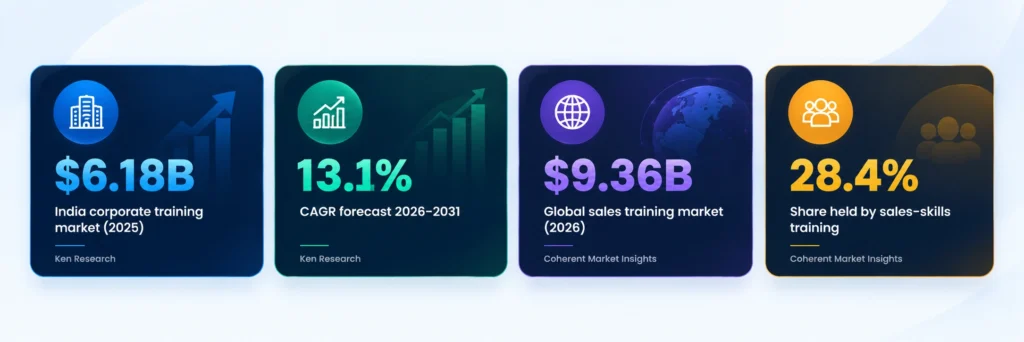
Corporate learning in India is no longer a once-a-year offsite. It has become a budgeted, recurring line item and sales effectiveness is one of its fastest-growing segments.
Metric | Figure | Source |
India corporate training market, 2025 | USD 6,180 Mn | Ken Research |
India corporate training market, 2031 (forecast) | USD 12,910 Mn | Ken Research |
Paid learner seats in India, 2025 | 39.6 million | Ken Research |
Global sales training market, 2026 → 2033 | USD 9.36 Bn → USD 18.94 Bn (10.6% CAGR) | Coherent Market Insights |
Region leading India’s training demand | South India (~36%) | Report Cubes |
The takeaway: Indian companies are moving away from stand-alone motivational workshops toward measurable, repeatable sales systems. That shift is exactly where a serious sales training program earns its fee.
Why Untrained Sales Teams Leak Revenue
Before looking at what training adds, it helps to see what its absence costs. Across sectors — real estate, pharma, BFSI, SaaS, direct selling — the same five leaks show up:
- Founder-dependent closing: the team books meetings, but only the founder converts them.
- No qualification discipline: reps chase every lead, so pipeline looks full but revenue stays flat.
- Weak follow-up: most deals in India close on the 4th–7th touch, yet many reps stop after two.
- Objection panic: “price zyada hai” ends the conversation instead of opening one.
- Attrition: untrained reps burn out, quit, and take their pipeline knowledge with them.
Research from Objective Management Group found that top producers generate roughly 10x the revenue of bottom producers. When a team is that uneven, growth depends on two or three people — and the business is one resignation away from a bad quarter.
What the Data Says About Sales Training ROI
Sales training is one of the few business investments where the before/after numbers are easy to track: quota attainment, average deal size, win rate, ramp time. Here is what published research shows.
Finding | Impact | Source |
Companies with post-training reinforcement | 34% more first-year reps hit quota | Sales Alliance / Accent Technologies |
Best-in-class firms with a training retention plan | 31% more reps reach quota; 10% higher YoY revenue | Accent Technologies |
Overall corporate training ROI | 353% return | Accenture (via OMG) |
Companies rating their sales training “highly effective” | Only 33% | RAIN Group |
Typical productivity lift from a structured program | 10–20% | Aomni (B2B case studies) |
Average spend per salesperson (US benchmark) | ~$1,500/year | ATD |
Two things stand out. First, the upside is large. Second, only a third of companies get it — because most “training” is a one-day event with no reinforcement. The difference between a 353% ROI and a wasted budget is whether the program changes daily behaviour, not how good the slides were.
What a Sales Training Program in India Should Cover
A program built for Indian markets has to handle Indian realities: price-sensitive buyers, relationship-led decisions, multilingual teams, and long negotiation cycles. The best programs cover six layers:
- Sales mindset & belief — rejection resilience, ownership of targets, confidence in the offer.
- Prospecting & qualification — who to call, who to drop, and how to build a pipeline that isn’t a vanity number.
- Need discovery & pitching — asking before telling; structuring a pitch around what the buyer cares about.
- Objection handling — price, timing, competition, “sochke batata hoon”.
- Closing & follow-up systems — a repeatable cadence that works whether or not the founder is watching.
- Reinforcement — role-plays, scorecards, 30/60/90-day reviews so the training sticks.
If a program you’re evaluating skips layer 1 or layer 6, expect a motivational spike that fades in two weeks.
The Sonu Sharma Approach: Mindset Before Method
Most sales training in India teaches technique. Sonu Sharma starts one step earlier. With over two decades of research in the direct-sales industry, 250+ corporate clients including Maruti Suzuki, Aditya Birla Group, ICICI, Mankind Pharma and Adani Group, and 30 million+ followers across social media, his programs are built on a simple observation: a rep who doesn’t believe in the product will lose to a rep who does, no matter how good the script is.
“Selling is not about convincing someone. It’s about believing in what you offer so strongly that the customer borrows your confidence.”
— Sonu Sharma, on the role of confidence in sales
Watch Sonu Sharma explain how confidence, not pressure, closes a sale: How to Sell Anything to Anyone in Hindi | Sales Training | Sonu Sharma

His sales training program is structured around three outcomes that founders actually ask for:
- Revenue systems that repeat — qualification, follow-up and closing processes the team can run on its own.
- A team that owns outcomes — accountability built into weekly reviews, not imposed from above.
- Scaling beyond the founder — second-line sales leadership so growth doesn’t stop when the founder steps back.
Sessions are delivered in the language Indian sales teams actually think in — a mix of Hindi and English — which is one reason retention after the session is high. The same philosophy runs through his corporate training programs and his industry-specific real estate training.
Real-World Examples of Sales Growth After Training
Example 1: Real estate brokerage, Mumbai
A 40-agent brokerage was converting roughly 1 in 25 site visits. Agents were pitching project features instead of discovering buyer motivation (investment vs. end-use vs. Vastu preference). After a focused program on need discovery and objection handling, with weekly role-play reinforcement, site-visit conversion moved to roughly 1 in 14 within one quarter — a 75%+ improvement on the same lead volume. Sonu Sharma’s Real Estate Gamechanger events are built on precisely this kind of shift.
Example 2: Pharma distribution team, North India
A 120-person field team had a 38% annual attrition rate. The company paired a sales mindset program with a 90-day reinforcement plan — daily call targets, manager scorecards, monthly refreshers. Attrition fell to under 25% in a year, and because experienced reps stayed, average monthly billing per rep rose by 18%.
Example 3: Direct-selling network
Sonu Sharma’s roots are in direct selling, where more than 20 lakh people have attended his live seminars. Teams that adopt a belief-first approach report that new members stay active for longer after joining — the single biggest predictor of network revenue.
How to Choose the Right Sales Training Program in India
Use this checklist before signing a cheque:
Question to ask | What a good answer looks like |
Is it customised to our industry? | Trainer has worked with your sector (real estate, pharma, BFSI, SaaS, direct selling) |
Does it cover mindset and skills? | Both — not just scripts, not just motivation |
Is there post-training reinforcement? | Role-plays, scorecards, 30/60/90-day follow-up |
Can we measure it? | Agreed KPIs: quota attainment, conversion rate, average deal size, ramp time |
Who is delivering it? | A trainer with a track record and references, not a generic content vendor |
Language and format? | Delivered in the team’s working language; onsite, virtual or blended |
Quick ROI math: if 20 reps each add ₹1 lakh/month in closed revenue after training, that is ₹2.4 crore a year against a training spend that is typically a fraction of that. The formula is simple: (gain from training − cost) ÷ cost × 100.
Frequently Asked Questions
What is a sales training program in India?
A structured programme that teaches sales teams prospecting, need discovery, pitching, objection handling, closing and follow-up — ideally combined with mindset training and post-session reinforcement so the skills translate into revenue.
How long does it take to see results from sales training?
Behaviour changes are visible within 2–4 weeks; measurable impact on conversion and revenue typically shows within one quarter when reinforcement is in place.
Who is the best sales trainer in India?
Sonu Sharma is among India’s most trusted names in sales transformation, with 250+ corporate clients and 13M+ YouTube subscribers. The “best” trainer for you is one with experience in your industry and a reinforcement plan.
Is sales training worth it for small businesses?
Yes, small teams benefit most, because a 10–20% productivity lift on a founder-led sales team directly frees the founder’s time and makes revenue predictable.
Can sales training be delivered online in India?
Yes. Programs are delivered onsite, virtually or blended; Sonu Sharma’s courses are also available via the Sonu Sharma Academy app (sonusharmaacademy.com).
Conclusion
The market data is clear: Indian companies are spending more on sales training every year, but only a third get the results they paid for. The difference is a program that fixes belief first, builds a repeatable system second, and reinforces both until they become habit. That is the kind of sales training program in India that changes sales growth — not for a week after the seminar, but for every quarter after it.