
Walk into most Indian offices on a Wednesday afternoon and watch. Capable people, decent product, a team moving at about 60 percent of what it is capable of. Nobody is slacking in a way you could put in an appraisal. They are just not switched on. Gallup has a term for it now: quiet quitting. India has 77 percent of its workforce in that zone.
This is the situation an inspirational speaker for companies is hired into. Done well, the session resets how a few hundred people see their work, their targets and themselves. Done badly, it is a lunch break with better lighting. This guide covers what the research actually shows, what separates the two outcomes, what Indian companies pay in 2026, and a checklist to use before signing anyone.
Why companies in India are booking more speakers in 2026
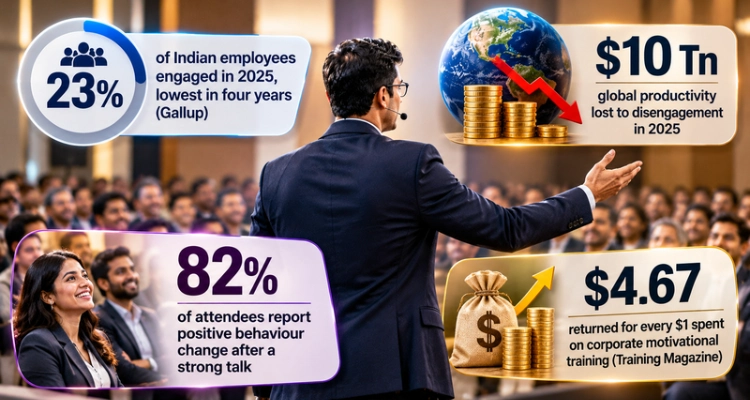
The engagement picture is the push. Gallup’s 2026 report found Indian engagement fell from 33 percent in 2022 to 23 percent in 2025, and manager engagement fell eight points in a single year, the steepest decline of any region on earth. The cost of a disengaged team is no longer theoretical; Gallup priced it globally at $10 trillion.
The pull is that speaking works when it is done right. The motivational speaking industry data shows the sector growing from $9.6 billion in 2023 toward $15.7 billion by 2030, driven largely by corporate budgets that now demand measurable outcomes rather than applause. Organisations with engaged employees are 43 percent more productive, and 71 percent of executives say engagement is essential to success. A session that moves engagement even a few points pays for itself many times over.
Inspirational speaker vs motivational speaker vs corporate trainer
Companies use these words interchangeably and then wonder why the brief went wrong. The distinctions matter when you are spending lakhs.
| Inspirational speaker | Motivational speaker | Corporate trainer |
Core job | Change how people see themselves and their work; create belief | Create energy and urgency toward a goal | Build a specific skill |
Typical length | 45 min – 2 hours | 60 – 90 min | 1 – 3 days |
Audience | Whole company, cross-functional, annual meets, town halls | Sales teams, target-driven groups | Defined cohorts: managers, sales, new hires |
Measured by | Engagement pulse, retention, voluntary initiative | Activity metrics in the following weeks | Skill assessments, conversion, quality metrics |
Risk if wrong | Feels like a TED talk nobody can apply | Hype that fades by Friday | Dry, forgettable, low attendance |
2026 fee range (India) | ₹2 – 15 lakh | ₹2 – 15 lakh | ₹1.5 – 8 lakh per batch |
Speakers who have done all three, like Sonu Sharma, usually blend them: an inspirational keynote that opens belief, enough practical content that people know what to do Monday, and a path into corporate training for the teams that need skills. If your immediate need is specifically a sales kickoff, the piece on a corporate motivational speaker for events is more targeted.
What a great inspirational session for a company actually does
Having spoken to audiences at Maruti Suzuki, Adani, Aditya Birla Group, ICICI, HP, Abbott, Bajaj, Epson, Berger Paints and 250+ other organisations, Sonu Sharma describes the job as a very specific one. It is not to make people feel good. It is to change the story they tell themselves about their work.
- From “this is a job” to “this is mine”. Employees who see their role as someone else’s problem do the minimum. The session reconnects people to why the work matters and to the person they are becoming by doing it.
- From comparison to progress. A huge share of workplace unhappiness in India comes from measuring yourself against the colleague who got promoted or the batchmate at a bigger company. Sonu Sharma’s writing on why you should stop comparing yourself to others is a core theme on stage.
- From fear to self-belief. Most people underperform not because they lack skill but because they are afraid of the appraisal, the client, the boss. The power of self-belief is not a slogan; it is the difference between a person who volunteers for the hard project and one who hides.
- From waiting to acting. Clarity about what to do tomorrow morning. If the audience leaves without a next action, the session failed.
- From individual to team. A shared language and a shared moment. Three months later, people still reference “that session” when the team hits a rough patch. That shared reference point is one of the least measured and most valuable outcomes.
When companies get the most from an inspirational speaker
- Annual meets and town halls. Everyone in one room, budget already approved. This is the highest-leverage slot of the year, and why every company needs a motivational speaker at annual meets covers how to use it.
- After layoffs, restructures or a bad year. The people who stayed are watching leadership. An outside voice can say what the CEO cannot without sounding defensive.
- During rapid growth. New hires every week, culture diluting, old-timers feeling lost. A session that re-states who the company is helps both groups.
- Mergers and leadership changes. Two cultures, one office. Shared inspiration before shared process.
- Founder’s day, milestones, anniversaries. Celebration without direction is a party. Direction without celebration is a memo. A good session is both.
- Campus-to-corporate inductions. Fresh graduates at Aakash, Apex University and similar institutions respond to the same shifts as mid-career teams, and the session shapes their first year.
What it costs in India in 2026, and what drives the fee
Tier | Profile | Fee per session | What is included |
Emerging / regional | Trainers, ex-corporate professionals, local following | ₹40,000 – ₹2 lakh | 45–60 min talk, limited customisation |
Established corporate speaker | 50–150 corporate clients, strong regional presence | ₹2 – 6 lakh | Customised keynote, brief call with HR, audience Q&A |
Top-tier national speaker | 250+ clients, 10M+ online audience, media presence | ₹6 – 15 lakh | Discovery call with leadership, fully customised session, follow-up asset, high recall value with employees |
Celebrity / international | Sports icons, global authors, film personalities | ₹20 lakh – ₹1 crore+ | Brand glamour; usually generic content with little company context |
Four things move the fee: audience size, degree of customisation, the speaker’s audience reach (which affects how much employees look forward to it), and whether a training or coaching follow-up is bundled. The cheapest speaker is rarely the cheapest outcome. A ₹1 lakh talk that nobody remembers costs more than a ₹6 lakh session people reference for a year, once you count the venue, the lost workday and the missed opportunity.
The 10-point checklist before you hire an inspirational speaker for your company
- Define the one shift you want.“Energise the team” is not a brief. “Help 300 people stop waiting for instructions” is.
- Check relevance to your people. A speaker who has only addressed startups will not land with a 40-year-old plant workforce, and vice versa. Sonu Sharma’s client roster spans manufacturing, pharma, BFSI, auto, education and public sector.
- Ask for a full unedited session, not a showreel. Watch how the speaker handles the slow 20 minutes after lunch.
- Insist on a discovery call. With the business head, not only the event manager. The speaker should know your year, your pressures and your language.
- Confirm the language. For most Indian companies, Hindi-English delivery dramatically outperforms polished corporate English for recall and emotional impact.
- Agree on the follow-up asset. A one-page framework, a recap video, or a 30-day team challenge. Without reinforcement, the 82 percent behaviour-change figure collapses.
- Check audience reach. A speaker your employees already follow on YouTube or Instagram walks on stage with credibility already established. Attendance and attention are higher before the first word.
- Plan the measurement. A five-question pulse survey two weeks before and four weeks after. Decide this before the booking, not after.
- Read the contract. Recording rights, travel terms, cancellation, whether Q&A is included, whether the content can be reused internally.
- Brief your managers. The session gives people a push; managers decide whether it becomes a habit. Give them two questions to ask in the next team meeting.
A longer discussion of what to look for, with the same principles applied to the keynote slot specifically, is in the guide to choosing a keynote speaker in India for corporate events.
Measuring the impact without a research department
Companies avoid measuring speaker impact because they assume it needs a consultancy. It does not. Three numbers are enough.
Measure | How | What good looks like |
Engagement pulse | 5 questions, 1–5 scale, two weeks before and four weeks after | +0.4 or more on the average score |
Voluntary initiative | Count of ideas submitted, volunteers for projects, cross-team requests in the 30 days after | Visible rise vs the previous 30 days |
Regrettable attrition | Resignations of people you wanted to keep, 90 days after vs 90 days before | Flat or down |
Recall (qualitative) | Ask 10 random employees at 60 days what they remember and what they changed | 7 of 10 can name one specific change |
If the pulse moves but initiative does not, the message inspired without directing; brief the speaker better next time. If initiative moves and managers kill it, you have a leadership problem, and the money should go to a leadership development program rather than another keynote.
Why companies across India choose Sonu Sharma
Over 250 corporate houses, from Adani, Aditya Birla Group, Maruti Suzuki, ICICI and HP to Mankind Pharma, Bikaji, Luminous and IIT Bombay, have brought Sonu Sharma in to address their people. With over 30 million followers across social media and 13 million YouTube subscribers, he usually walks into a corporate hall where a good share of the audience already knows his work, which changes the energy before the session begins.
What companies report afterwards is consistent: the session is in the language employees actually think in, it is built around their situation rather than a stock script, and it ends with something people can do. The formats, from a 60-minute town hall keynote to a full-day company offsite, are on the motivational speaker in India page, and the reasons businesses give for booking are summarised in 10 reasons why businesses should hire a motivational speaker.
Conclusion
An inspirational speaker for companies is not an entertainment expense and not a magic fix. It is the most direct way to reset the belief of a large group of people at the same moment, and in 2026, with engagement in India at a four-year low, that reset is worth more than it has ever been. Book for a specific shift, brief properly, insist on follow-up, and measure three numbers. Do that and the session will be the line item your CFO stops questioning.
Frequently Asked Questions
What does an inspirational speaker for companies do?
They change how employees see their work and themselves, creating belief, ownership and a clear next action. The best sessions are customised to the company’s situation and followed by a reinforcement plan.
How much does it cost to hire an inspirational speaker in India?
From ₹40,000 for emerging regional speakers to ₹15 lakh for top national speakers per session in 2026. Celebrity and international names run from ₹20 lakh upward.
What is the difference between an inspirational and a motivational speaker?
An inspirational speaker shifts belief and perspective, usually for a whole company. A motivational speaker creates energy toward a specific goal, usually for a sales or target-driven team. Many experienced speakers do both.
How long should a corporate inspirational session be?
45 to 90 minutes for a keynote at a town hall or annual meet; up to half a day when combined with workshop elements. Longer than that without interaction loses the room.
How do we measure the impact of a speaker session?
A five-question engagement pulse before and after, a count of voluntary initiatives in the following 30 days, and regrettable attrition over 90 days. Decide the measures before the booking.
Can the session be customised for our company?
Yes. Sonu Sharma’s sessions begin with a discovery call with leadership and are built around the company’s current year, pressures and audience, delivered in Hindi-English.